
Eyelid surgery for a rolled-in lid (entropion) or a drooping outward lid (ectropion) typically holds for life when done at the right age with the right amount of tissue adjusted. Both conditions force the eye into constant contact with lashes and fur or leave the surface exposed to wind and debris, which sets up corneal ulcers, scarring, and chronic conjunctivitis. Drops and ointments calm the symptoms but cannot change the lid position causing them, so the fix has to be structural.
At Lebanon Animal Hospital, we examine the eye and the lid together before making any recommendation, because breed, age, severity, and existing corneal damage all change what the right procedure looks like. As an AAHA-accredited practice, we provide soft-tissue surgical care for dogs and cats in Lebanon with low-stress handling, careful anesthetic monitoring, and a measured approach to how much lid tissue is adjusted. If your dog or cat is squinting, tearing, or pawing at an eye that does not look right, book a consultation and we will take a close look.
The Fast Answers on Eyelid Surgery
- Entropion rolls the eyelid inward so lashes and fur scrape the cornea, while ectropion droops the lid outward and leaves the inner surface exposed. Both are highly treatable once we pin down which one your pet has.
- These are not cosmetic quirks: squinting, tearing, and pawing at the eye are signs of real pain, and lasting corneal damage becomes more likely the longer they go unaddressed.
- Surgical correction is usually permanent when the pet has finished growing and the lid is adjusted conservatively, with most pets feeling dramatically more comfortable soon after they heal.
- A cone and a short course of eye medication through the first couple of weeks protect the repair while it settles, and a recheck confirms the lid landed where it should.
Squinting, Tearing, or Discharge: When Should the Eye Worry You?
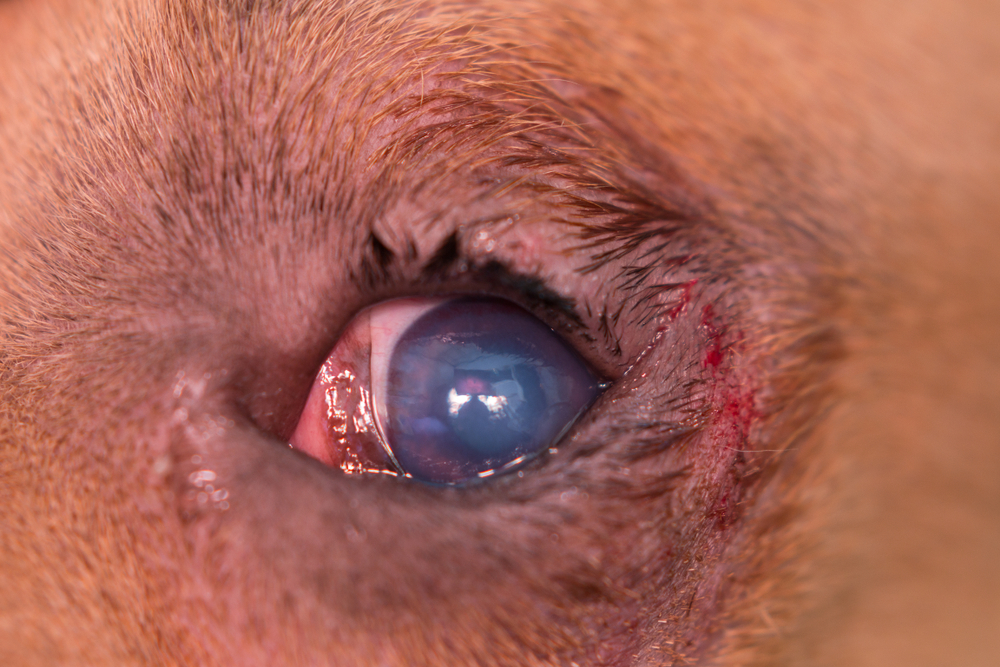
The signs of a lid problem are the signs of an uncomfortable eye. Squinting, excessive tearing, pawing at the face, and keeping an eye held shut are all signs of eye pain that deserve attention rather than a wait-and-see approach. This is a pet telling you the surface of the eye hurts.
Here is what tends to show up at home, and what it can turn into:
| What you notice | What it may mean | Why it matters |
| Squinting or an eye held shut | Ongoing surface pain | Rarely resolves on its own; usually structural |
| Watery or overflowing tears | Constant irritation of the cornea | A sign the eye is trying to protect itself |
| Thick or colored discharge | Irritation tipping into infection | Points to a lid not closing or clearing properly |
| Redness of the lid or white of the eye | Inflammation from friction or exposure | Fuels scarring over time |
| Pawing or rubbing the face | The eye is genuinely bothering your pet | Rubbing can worsen the damage fast |
The complications diverge by condition. Left unaddressed, the friction of an inward-rolling lid can wear the surface into corneal ulcers that put vision at risk, so entropion is the one that threatens sight. Ectropion causes a slower, steadier kind of trouble, with chronic irritation and recurrent infections, and ongoing eye discharge, especially when thick or colored, is a common sign that an outward-sagging lid is the problem.
The through-line is simple: the longer either condition goes on, the more complicated the repair becomes, because scar tissue and a damaged cornea are harder to work around. If your pet is showing these signs, have the eye evaluated sooner rather than later. Caught early, most pets do well and their vision remains intact. Caught late, corneal scarring leads to vision loss.
Is My Pet’s Lid Rolling In or Drooping Out?
A lid goes wrong in one of two directions. Entropion rolls inward and drags lashes and fur across the cornea, while ectropion sags outward and leaves the pink inner lid exposed to wind, dust, and drying air. Either way, the eye loses the protection a well-fitting lid is supposed to give it.
Both conditions sometimes show up in the same pet at once, and several other eye issues can look just like them, so a careful look matters before anyone talks about surgery. A red, watery, squinty eye could be a rolled lid, a stray lash, a foreign body, or an ulcer. That is why our veterinarians look at the whole picture during an eye exam: lid position, tear production, and the health of the corneal surface, rather than one symptom in isolation. If something about your pet’s eye looks off, call us and we can help you decide whether it needs a same-week or same-day look.
Is Your Pet Built for Eyelid Trouble? Breeds and Other Risk Factors
Genetics and facial structure drive most lid malpositions, and many eyelid disorders trace back to the shape of the face a pet was born with. Because these hereditary conditions run in certain bloodlines, dogs with heavy skin folds, deep-set eyes, or a flat-faced build carry a higher baseline risk.
Entropion turns up often in Shar-Peis, Chow Chows, Bulldogs, Rottweilers, and many retriever and mastiff-type dogs, while ectropion shows its hand in droopy-eyed breeds like the Bloodhound, Basset Hound, Saint Bernard, and Cocker Spaniel. Some heavy-jowled giants have both on the same eye. Cats are not exempt, and flat-faced breeds like Persians and Himalayans see more eye-surface trouble because their shortened muzzles change how the lids sit. Beyond breed, a few other things push the risk up:
- Age-related tissue changes: The muscle and skin around the eye can lose tone with age, letting a lid droop or roll.
- Chronic inflammation: Long-standing irritation or infection can scar and tug the lid out of position.
- Previous injuries: A healed wound near the eye can shorten or distort the lid margin.
- Pain-induced squinting: A painful eye held tightly shut can roll the lid inward temporarily, a spastic entropion that sometimes resolves once the underlying pain is treated.
Questions about your breed’s tendencies are worth raising during routine wellness and preventive exams so we can watch the lids before a small roll becomes a scratched cornea.
How Do Veterinarians Pin Down Which Eyelid Problem It Is?
Diagnosis starts with a careful eye exam that looks at the lid and the eye surface together, pairing a close look at lid position with ocular tests that measure tear production and reveal corneal damage. The pieces we typically walk through:
- Lid position and movement: We assess whether the margin rolls in, sags out, or both, and how much of the lid is affected.
- A tear test: Low tear production changes the plan, since a dry surface is more vulnerable and may need addressing alongside the lid.
- Corneal staining: A harmless dye highlights ulcers or abrasions so we know whether the cornea has already taken damage.
- A numbing drop: Topical anesthetic helps sort a genuinely rolled lid from a pet squinting hard from pain. If the lid relaxes to normal once the eye stops hurting, we are likely dealing with spastic entropion rather than a fixed anatomical problem.
Part of the workup is also looking for eyelash problems, since misdirected or extra lashes cause similar irritation and sometimes travel alongside a rolled lid. Because the process goes better when a pet is calm, we lean on low-stress handling and pain assessment so an already sore eye gets examined gently.
From Stitches to Surgery: Ways to Set the Lid Right
Treatment runs a spectrum from temporary, reversible measures to permanent surgical correction, and the right choice depends on your pet’s age, the cause, and how the eye looks today. Some rolled lids need a holding measure first, and some need the definitive fix. Here is how we think about it.
Are There Temporary or Short-Term Measures First?
Temporary measures often come first, and they matter most for the young and the acutely sore. Permanent surgery on a face that is still growing risks overcorrecting once the head finishes filling out, so a short-term approach buys time. For a young puppy or a pet squinting from pain, temporary eyelid tacking uses a few small sutures to hold the lid in a better position and can be repeated until the face has matured. In many young pets, the lid comes to sit normally on its own.
When Is Permanent Surgical Repair the Answer?
When the problem is clearly structural and the pet has stopped growing, permanent eyelid surgery offers a lasting fix, with tissue adjusted conservatively to match each pet’s anatomy. The technique depends on the eye: an entropion repair typically removes a small crescent of skin to roll the margin back out, while an ectropion correction tightens or shortens the lid to lift it back into contact with the eye. The guiding principle is restraint, because taking too much tissue can flip the problem to the opposite malposition. Throughout, a customized anesthesia protocol and continuous monitoring keep your pet safe and pain-free, and this delicate work is where our team’s hands-on surgical experience earns its keep.
Is Entropion Different in Cats?
Cats often follow their own script. Entropion in cats tends to appear later in life and often alongside other surface eye disease, so a feline patient sometimes needs a combination of techniques. Where a young dog’s entropion is often a straightforward conformational issue, a cat’s may be tangled up with chronic conjunctivitis or scarring from an earlier eye problem, so the plan for a cat frequently addresses more than the lid alone.
What Happens During Eyelid Surgery, Step by Step?
Surgery day follows a predictable rhythm built to keep your pet safe and comfortable from check-in to wake-up. We confirm the plan that morning, tailor anesthesia to your pet, and control pain from the start. Monitoring continues from the moment your pet goes under until they are fully awake.
- Confirming the plan: We recheck the eye and the surgical plan the morning of, so any change in the lid or cornea is accounted for.
- A tailored anesthesia protocol: The anesthetic plan is built around your pet’s age, breed, and health, which matters especially for the flat-faced breeds prone to these lid problems.
- Pain management from the start: Pain control begins before the first incision, because a comfortable patient recovers better.
- Continuous monitoring: We track heart rate, oxygen levels, temperature, and blood pressure, with a team member watching the whole time.
- A gentle recovery from anesthesia: Your pet wakes up in a quiet, warm space with someone nearby until they are alert and stable enough to go home.
Most eyelid surgeries are same-day procedures, and pets head home that afternoon or evening with a cone in place and clear discharge instructions. The eye may look a little swollen and the sutures will be visible, which is entirely expected in the first days.
The Two Weeks That Do the Healing: Home Care After the Repair
Recovery is mostly about protecting the repair while it heals, and it is very manageable at home. The first two weeks do the heavy lifting; after that, most pets are back to their normal, comfortable selves.
What Should I Watch For in the First Few Days?
The first days are about telling normal healing apart from a genuine problem, and the difference is usually clear once you know what to look for.
| Normal recovery | Call us about |
| Mild swelling and redness around the lid | Swelling that worsens after day two or three |
| A little clear or slightly pink discharge | Thick, yellow, or green discharge |
| Sutures visible and intact | Sutures missing, or the incision opening |
| Your pet a bit quiet the first evening | Squinting that gets worse, not better |
| Wanting to rub, but the cone stopping them | An eye that looks cloudy or newly painful |
The single most important tool in recovery is the Elizabethan collar. One good scratch or rub can tear out sutures and undo the whole repair in seconds, so the cone stays on around the clock, including overnight, until we clear it at the recheck. Yes, pets protest it. It is still non-negotiable.
Aftercare usually means a topical eye ointment or drops and often an oral anti-inflammatory or pain reliever, on the schedule we send home. Getting drops into a squirmy pet is its own small art, and it helps to follow a calm, consistent routine for administering eye medications: steady the head, approach from behind or the side, and finish with a treat. If anything about the healing looks off, reach out with any post-operative questions rather than waiting it out.
How Long Is the Healing Timeline?
The full arc is short. Here is the rough timeline:
- Days 1 to 3: The most swelling and the most vigilance about the cone.
- Days 10 to 14: Skin sutures typically come out, once the incision has knit together.
- Weeks 2 to 4: The lid margin settles into its final position as swelling resolves and the tissue relaxes.
- The recheck: A follow-up visit lets us confirm the lid landed where it should and the cornea is healing.
Because we deliberately correct conservatively to avoid overshooting, a small number of pets, particularly severe cases or very loose-skinned breeds, may benefit from a minor second-stage revision once everything has settled. That is not a failure of the first surgery; it is the safest path to the right final position. We would rather nudge twice than overshoot once.
What Kind of Results Can You Count On?
The prognosis for eyelid surgery is very good when done by an experienced team at the right time. Most pets are noticeably more comfortable once the eye heals, and the relief can be dramatic, especially for a pet who has been squinting and rubbing for months. The lid does its job again, the cornea is protected, and the daily discomfort fades.
A handful of factors shape how smoothly it goes:
- Severity of the malposition: A mild roll is a simpler fix than a severe one with a lot of tissue involved.
- Overall eye health going in: An eye with an active ulcer or significant existing damage has more healing to do.
- A mature facial structure: Waiting until the face has finished growing makes the correction more predictable and lasting.
- Quality of home care: Diligent cone use and medication during recovery genuinely protects the result.
Realistic expectations help. If the cornea already carries scarring from months of friction, a little haze can remain even after a perfect surgery. What the procedure reliably delivers is pain relief and protection from further damage, which is the real goal. If you show your dog, one more thing is worth checking: some breed registries have rules about corrective eyelid surgery in competing dogs, so confirm the policy before scheduling. Beyond that, keeping an eye on lid and corneal health at routine visits helps us catch any late changes early.
Eyelid Surgery Questions Pet Families Ask Us Most
Will my pet’s entropion or ectropion come back after surgery?
Entropion and ectropion rarely come back after a properly timed repair. A permanent correction done after the face has finished growing, with the lid adjusted conservatively, usually holds for life. A lid can shift again in very severe cases or extremely loose-skinned breeds, where a planned minor revision fine-tunes the result. Correcting on a still-growing puppy is the more common reason a repair needs revisiting, which is why we favor temporary tacking in the young until the anatomy stabilizes.
Is eyelid surgery painful for my dog or cat?
Your pet is fully asleep under anesthesia during the procedure and feels nothing. Afterward, we send home pain medication and an anti-inflammatory to keep the healing eye comfortable, and most pets are only mildly bothered for a day or two. The bigger nuisance is usually the cone rather than the incision. If your pet seems genuinely painful, is squinting more as the days pass, or stops eating, that is worth a call, but the typical recovery is far more comfortable than the constant irritation the surgery fixed.
Can entropion or ectropion be treated without surgery?
Drops and ointments can soothe the surface and treat a secondary infection or ulcer, but they cannot move a lid sitting in the wrong position, so they are a bridge rather than a cure for a truly structural problem. The one real exception is spastic entropion, where a painful eye squints the lid inward; treat the underlying pain and the lid may relax back to normal on its own. For young pets, temporary tacking holds the line until surgery is either needed or ruled out. A proper exam tells us which situation we are dealing with.
Let’s Get That Eye Comfortable Again
Entropion and ectropion are highly manageable, and a timely, precise correction restores comfort and protects your pet’s vision for the long term. The best outcomes come from eyes we see before scarring sets in, so early evaluation pays off. If your dog or cat is squinting, tearing, pawing at the face, or living with an eye that just does not look right, please schedule a consultation so we can take a close look and lay out the options.
As the county’s longest-running and only AAHA-accredited practice, Lebanon Animal Hospital brings diagnostics, anesthesia, and surgical care under one roof, with the low-stress handling and careful monitoring these delicate eyes deserve.