
The first question that follows finding a swollen lymph node is usually what caused it. Diseases passed from ticks, a passing virus, a dental infection; the causes are numerous, and testing is needed to know just how dangerous the issue is. Some swellings point somewhere even more serious: in dogs, several enlarged nodes at once raise the question of lymphoma, and ruling that in or out early changes what comes next.
Lebanon Animal Hospital provides veterinary care for dogs and cats in Wilson County, with an in-house laboratory, digital X-ray, and ultrasound on site for working up an enlarged node. When an infection, a parasite burden, or an internal illness could each be contributing, we can sample the node, run bloodwork, and keep testing until the findings fit together. AAHA accreditation sets the bar we hold that process to, and low-stress handling keeps an anxious dog or a hiding cat settled enough for a thorough exam. If you have felt a swelling on your pet, have it checked within a day or two; a node that stays enlarged or grows is worth seeing sooner rather than later.
Start Here: What a Big Node Is Telling You
- Lymph nodes swell when the immune system is working on something, and infection, allergies, immune disease, and cancer can all produce the same bump under your fingers.
- The pattern matters: one enlarged node near a wound or a bad tooth points somewhere local, while several firm, painless nodes at once raise the question of lymphoma in dogs.
- A fine needle aspirate takes seconds, most pets don’t need sedation for it, and the cells it collects usually answer the question that a hand on the neck can’t.
- Finding one cause doesn’t rule out a second one, so a good workup keeps testing until the findings fit together.
Where Are My Pet’s Lymph Nodes, and How Do I Check Them?
Lymph nodes are immune checkpoints that filter fluid and trap invaders, and they sit in the same spots on both dogs and cats. The lymph node locations within reach at home are beneath the jaw, ahead of each shoulder, in the armpits and groin, and in the dip behind each knee.
Most of the time you won’t find them at all, and that’s the whole point. A node you can suddenly feel is one that has been activated by something. Run your fingers over each spot about once a month, comparing left side to right as you go. There’s no chart to measure against; the job is simply noticing change.
Not every lump in those spots is a node, either. Fatty tumors, abscesses, cysts, and swollen salivary tissue all turn up in the same neighborhoods, which is one more reason a sample beats a guess.
Pick a routine that sticks, like the couch session after dinner. Cats tolerate this best folded into a lap, and most dogs read it as attention. If a spot feels larger or firmer than it did last month, that’s your signal to call, and our team can sort out what the difference means. Node palpation is also part of the exam our veterinarians run at every preventive visit, which is how plenty of changes get caught before anyone at home finds them.
What Makes a Lymph Node Swell Up in the First Place?
Swelling means immune cells are multiplying inside the node, either to fight something nearby or because abnormal cells have moved in. Infections, allergies, immune-mediated disease, and cancer all produce the same lump, which is why the pattern of swelling is where we start.
That pattern carries information before a single test runs. One enlarged node under the jaw with a fractured tooth above it, or one behind the knee on the leg with a cat scratch, usually points to something local. Nodes that come up everywhere at once suggest a body-wide response, or abnormal cells circulating. Firm and painless reads very differently than hot, tender, and swollen overnight, and a node that slides freely under the skin behaves differently from one anchored to the tissue beneath it.
Infections Are the Most Common Reason Nodes Get Big
Bacteria, viruses, fungi, and parasites all trigger the same reactive response. A local infection lights up whichever nodes drain that area, while a systemic one lights up several at a time. A handful of culprits account for most of what we see around here.
- Tick-borne: A single tick bite can transmit Ehrlichia and Anaplasma, which tend to show up as fever, lethargy, joint soreness, and lymph nodes that swell in several places at once. Lyme disease can do much the same thing.
- Bacterial: Dogs pick up leptospirosis from creeks, farm ponds, and standing water carrying wildlife urine, and it belongs on the list any time fever, lethargy, and swollen nodes arrive together. Mycobacteriosis is a rarer cause of chronic node and skin changes in cats.
- Fungal: Middle Tennessee sits in the stretch of the country where histoplasmosis lives in the soil, and inhaled spores can produce weight loss, coughing, and enlarged nodes weeks or months after the exposure. Blastomycosis comes out of damp ground near water and behaves much the same way.
- Feline viruses: In cats, feline leukemia virus suppresses immune function, keeps nodes enlarged for months at a stretch, and raises the risk of lymphoma later in life. Feline immunodeficiency virus does something similar on a slower timeline.
- Parasites: Toxoplasmosis, a heavy load of intestinal worms or Giardia, and a bad flea or tick burden all keep nodes reactive without ever making a pet look dramatically sick. Puppies and kittens show this version most often.
When the Cause Turns Out to Be Cancer
Canine lymphoma usually announces itself as firm, painless swelling in several nodes at once, in a dog who is still eating, still playing, and still acting entirely like himself. That disconnect is what makes it easy to shrug off for a few weeks.
Roughly one dog in fifteen will face the disease in their lifetime, and the odds for lymphoma in Golden Retrievers run closer to one in eight. That’s why we don’t take a wait-and-see approach to a hard node in a big dog. Lymphoma isn’t one illness, either. B-cell and T-cell forms behave differently, and low grade and high grade carry different outlooks, so pinning down the subtype shapes every conversation that follows.
Cats take a different route. Feline lymphoma settles in the intestinal tract far more often than in the nodes you can feel, which is why vomiting, diarrhea, and steady weight loss are frequently the only clues. Other tumors, including mast cell tumors and melanoma, spread into whichever node drains them, so we often sample the node nearest any suspicious lump even when the node itself feels fine.
Immune Disease and Vaccine Reactions
Autoimmune diseases cause the immune system to view normal cells as something that’s dangerous, and attacks. This can cause over-proliferation of immune cells, swelling the nodes. Immune-mediated hemolytic anemia is one of the most common, and has the body destroying its own red blood cells. Pale gums, sudden weakness, or dark urine put a pet in the same-day category rather than the wait-and-watch one. A recent vaccine can leave a nearby node briefly reactive too, usually for a week or two after the vaccine before it goes back to normal. None of these look any different from the outside, which is the whole argument for sampling rather than guessing.
How Quickly Should a Swollen Node Get an Appointment?
Most enlarged nodes should be examined within a day or two, and a handful need attention immediately. Anything that ballooned overnight, anything paired with pale gums or labored breathing, and any swelling pressing on the throat moves to the front of the line. Gradual, minor changes in a bright, comfortable pet can wait for a scheduled visit.
| How urgent | What you’re seeing | What to do |
| Emergency, today | Pale gums, weakness or collapse, trouble breathing or swallowing, a node that doubled overnight | Head straight to emergency care without waiting for an opening |
| Within 48 hours | A firm node you can clearly feel, several nodes up at once, swelling alongside fever, appetite loss, or lethargy | Call and get on the schedule |
| Within the week | A small, soft node near a healing scratch or a recent vaccine, in a pet who is otherwise bright and eating well | Book a recheck and keep watching for change |
When the right row isn’t obvious, call us and describe the lump under your fingers. Nobody is bothering us by asking.
A couple of things to skip while you wait. Don’t keep squeezing or massaging the swelling, because repeated handling inflames the tissue and makes the exam harder to read. Warm compresses won’t drain anything that matters here. And never restart leftover antibiotics or leftover steroids from a previous illness: a partial antibiotic course can blur the cytology, and steroids can wipe out the very cells that would have named lymphoma, delaying the real answer by weeks.
How Do We Figure Out Why a Node Is Swollen?
An exam maps the pattern, a needle sample reads the cells inside the node, and bloodwork plus imaging show whether anything else in the body is involved. Each step narrows the next one, and most pets get through all three in a single visit.
What the Exam Tells Us Before Any Test Runs
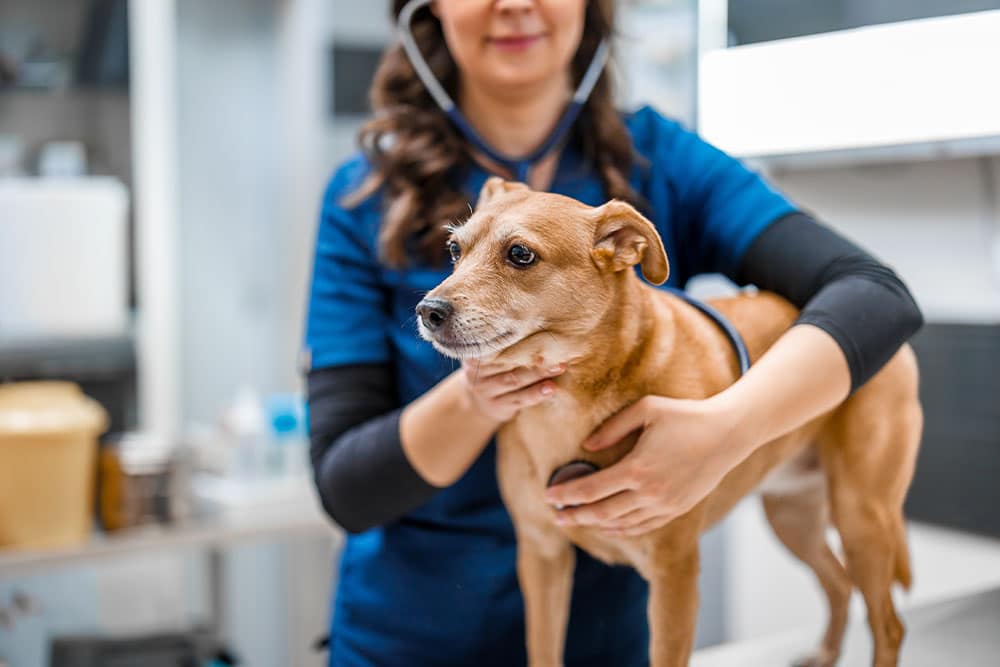
Palpation covers far more than size. We’re reading texture, symmetry, tenderness, and whether the node slides freely or feels stuck to what’s underneath. A soft, mobile node near a scabbed ear tells a different story than a rock-hard fixed one in a senior dog, and that read sets both the urgency and the order of everything after it.
Aspirate First, Biopsy If the Cells Don’t Settle It
Fine needle aspiration takes seconds, uses a needle no bigger than the one used for a vaccine, and most pets go through it without any sedation at all. The cells land on a slide, get stained, and get read under the microscope. Cytology answers a great deal: reactive changes from infection, inflammatory cells, or an unmistakable population of lymphoma cells. When individual cells can’t settle the question, a biopsy preserves the architecture of the tissue itself and answers which grade and subtype are in play. That’s a short anesthetic procedure, planned with pre-anesthetic bloodwork and a protocol built around your pet.
Bloodwork, Tick Testing, and Imaging
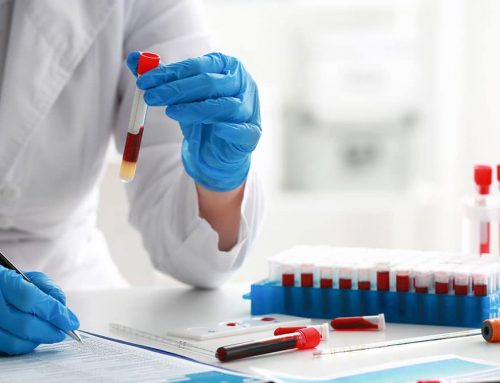
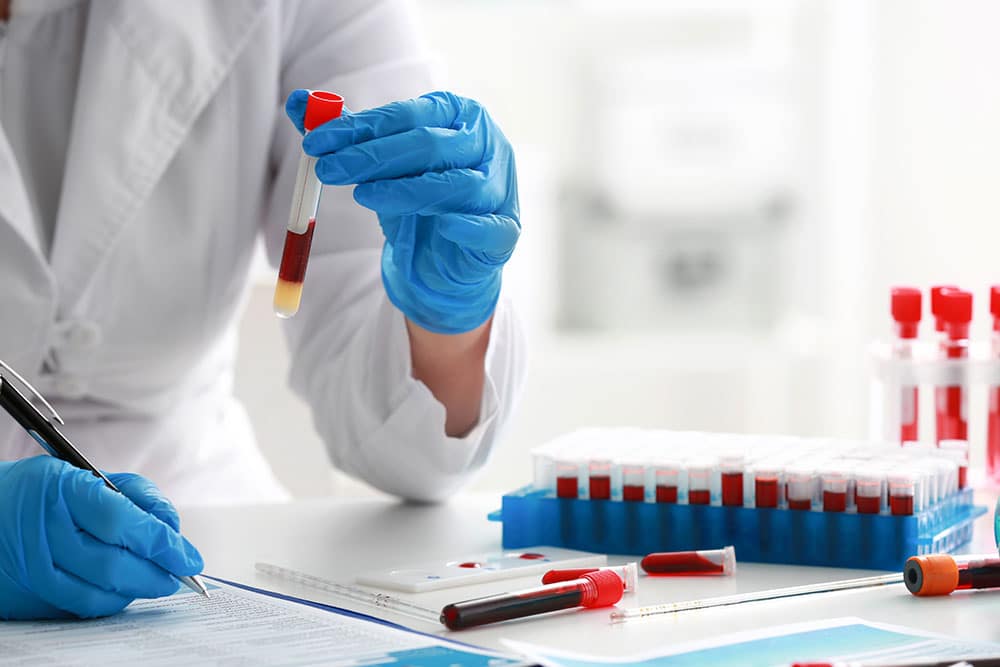
A complete blood count and chemistry panel screen for infection, anemia, and organ trouble, while tick-borne and fungal testing hunt for specific organisms. Chest radiographs and an abdominal scan show the nodes and organs your fingers can never reach, which is how an enlarged spleen or liver turns up and changes the plan. Running that work in house keeps the sequence moving instead of stretching it across weeks. When lymphoma is on the table, the same imaging is what stages the disease and shapes the outlook.
What Does Treatment Look Like Once We Know the Cause?
Treatment follows the diagnosis, never the other way around. Start an antibiotic on what later proves to be lymphoma and you’ve spent weeks you don’t get back. Once we know what we’re aiming at, the plan gets specific fast.
| What the workup found | The usual approach |
| Local bacterial infection | Targeted antibiotics plus treatment of the source, whether that’s a wound, an abscess, or an infected tooth |
| Tick-borne infection | A course of doxycycline, with recheck bloodwork to confirm the response |
| Fungal disease | Antifungal medication, often for months, with monitoring along the way |
| Feline leukemia or FIV | Supportive care, aggressive treatment of secondary infections, and closer monitoring for lymphoma |
| Immune-mediated disease | Immune suppression, usually starting with steroids and adjusted to the response |
| Lymphoma | Chemotherapy aimed at remission, referred to a veterinary oncologist and coordinated from our end |
With lymphoma, the honest target for most patients is remission, not cure. Protocols differ in how many visits they take and how much they disrupt your pet’s ordinary week, and dogs generally tolerate chemotherapy far better than people expect from the human version. The right choice depends on your dog or cat, on your family, and on what you want the coming months to feel like, so talk it through with us before you settle on anything.
Is There Any Way to Prevent Swollen Lymph Nodes?
Good wellness care prevents many reasons nodes may swell. The infectious causes are the preventable ones, and year-round parasite control plus current vaccines take most of those off the table. Nothing prevents lymphoma outright, but consistent preventive visits remain the most reliable way to catch it while the widest range of options is still open. Blood-based screening tests can flag lymphoma months before the first swollen node ever appears, which matters most for older dogs and higher-risk breeds like Golden Retrievers, Boxers, and Bernese Mountain Dogs.
Flea, tick, and heartworm prevention does more work here than anything else, since ticks carry the infections that swell nodes and a heavy flea burden keeps the immune system churning. Routine deworming and a yearly fecal check handle the intestinal side. Vaccines earn their keep too, particularly leptospirosis for dogs who swim, wade, or share a yard with wildlife, and the feline leukemia vaccine for any cat who goes outdoors.
Dental disease is the quiet one. A mouth full of infected tissue keeps the nodes under the jaw activated for years, and those happen to be the exact nodes families notice first. Dental radiographs show what’s happening below the gumline, where two thirds of every tooth lives and where most of the trouble hides. If it’s been a while since the last cleaning, that’s a source worth taking off the board.
Swollen Lymph Node Questions Pet Families Ask Us Most
Will a swollen lymph node ever shrink without treatment?
Reactive nodes often do settle by themselves. A node responding to a scratch, a mild skin infection, or a recent vaccine typically shrinks back over a week or two once the trigger clears. The trouble is that you can’t tell that node from a cancerous one by feel, and lymphoma doesn’t hurt either. A reasonable rule: anything still enlarged after two weeks, anything growing, and anything hard gets sampled rather than watched.
My dog acts completely normal with a big node. Does that mean it’s nothing?
Behavior is a poor guide with lymph nodes, unfortunately. Most dogs with early lymphoma feel great, eat everything offered, and greet you at the door exactly as usual, because the immune system hasn’t failed yet. Normal energy is good news for how well your dog will handle a workup and treatment, but it isn’t evidence the node is harmless. The lump is the symptom, and it deserves a look on its own.
Do cats show this differently than dogs?
Cats tend to be subtler. Their nodes are smaller and harder to find, and the most common feline lymphoma grows in the intestines rather than in nodes you can palpate, so weight loss, vomiting, or a cat who has quietly stopped finishing meals is often the first clue. Viral infections and heavy parasite loads sit higher on the feline list too. A cat losing weight deserves the same workup as a dog with an obvious lump.
You Found the Lump. Now Let’s Find Out What It Is
The stretch between finding a swelling and knowing what it means is usually shorter than families expect. A needle sample, some bloodwork, and a careful exam turn an unknown into a diagnosis and a plan, and the sooner that happens, the more choices stay available to you.
Whatever the answer turns out to be, you won’t be sorting it out by yourself. Bring your dog or cat to Lebanon Animal Hospital and we’ll start with our hands and go from there, at whatever pace the news calls for. Request an appointment while you’re still not sure the lump is real, because that’s the best time to look.