
A dog who has torn one cranial cruciate ligament stands a real chance of injuring the other, and it is not bad luck. The cruciate ligament is the dog's version of the human ACL, and it usually fails through slow degeneration rather than a single bad step, so whatever weakened the first knee is often at work on the opposite side. A torn cruciate does not heal on its own, and for most dogs surgical stabilization is what returns that leg to work. Catching the second knee early, while the limp still comes and goes, limits how much arthritis sets in and keeps more treatment options open.
A new limp leaves a lot of open questions, and you deserve a clear read on what that leg is doing. Lebanon Animal Hospital provides veterinary care for dogs in Lebanon, and our AAHA-accredited team pairs a hands-on exam of both knees with digital X-rays to see how much the joint has changed. From there we talk you through the surgical options, including TPLO, TTA, and extracapsular repair, while laser therapy and chiropractic care support your dog's comfort and even movement so the good leg is not carrying everything. If your dog's gait has shifted or an old limp is back, book an exam and we will tell you where that knee stands.
What a Torn Knee Means for Your Dog and the Months Ahead
- A torn cranial cruciate ligament (CCL) is the canine version of a torn ACL, and it usually frays over months instead of snapping in one bad moment.
- Sudden hind-leg limping, trouble rising, and sitting with one leg kicked out to the side are the signs families notice first.
- Surgery gives most medium, large, and giant breed dogs the best long-term function, while very small dogs sometimes do well with rest, medication, and rehab.
- Rehabilitation, weight control, and steady low-impact activity protect both the repaired knee and the one on the other side.
What Does a Torn ACL Look Like in a Dog?
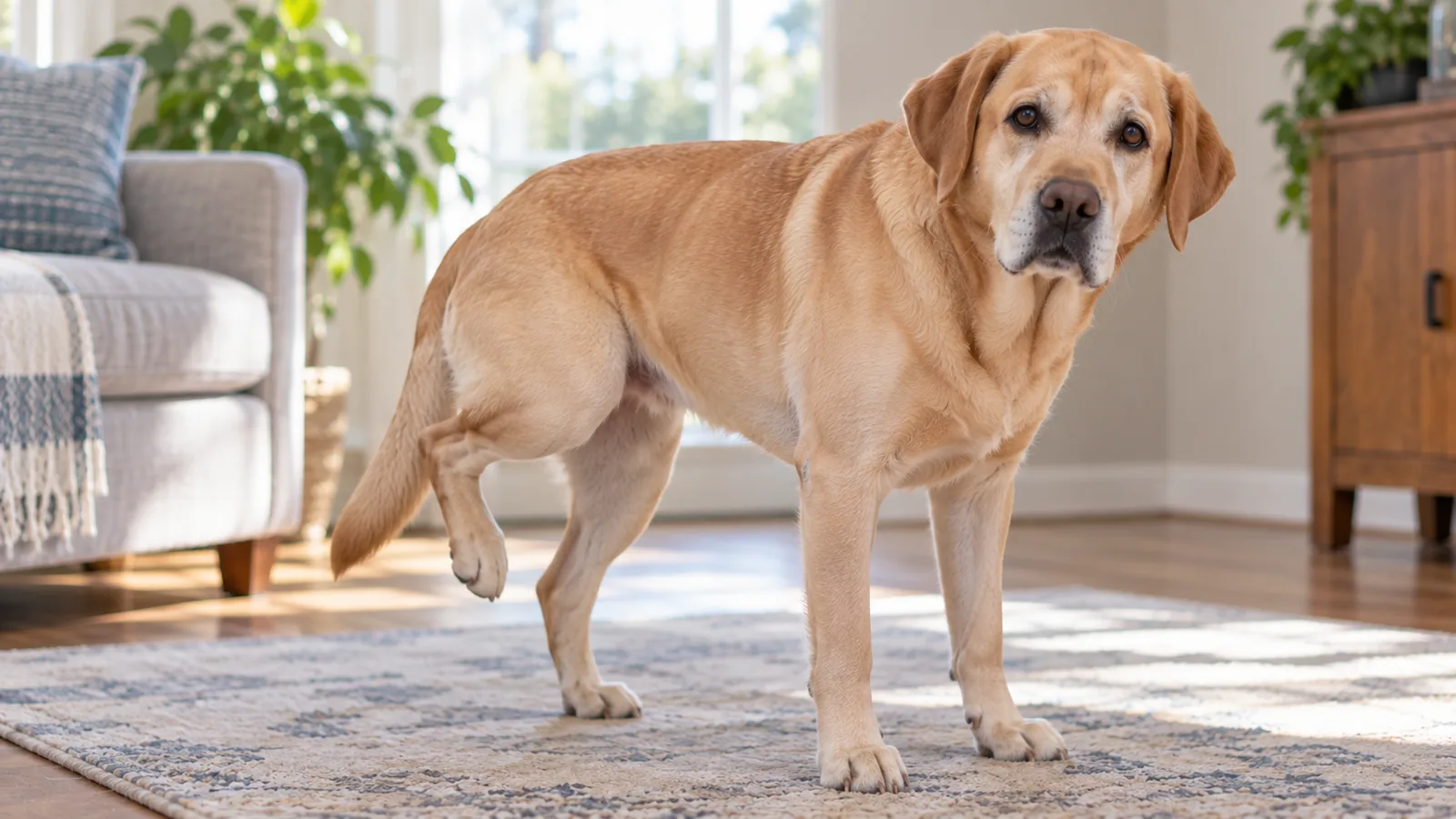
Sudden hind-limb limping after a hard turn in the yard is what most families notice first, but a partial tear tends to look like stiffness that eases with a few days of rest and returns the moment your dog runs again. Both patterns point at the same joint.
Watch for these over a week or two:
- The sit test: a dog with a sore knee flops one hip out to the side instead of folding both legs neatly underneath.
- Slower everyday movement: stairs, the jump into the car, and getting up after a nap all take longer than they used to.
- Swelling on the inside of the stifle: run a hand down both knees and the sore one often feels thicker.
- Toe touching: the foot rests on the ground at a standstill but carries almost nothing at a trot.
- Stiff mornings, stiff evenings: your dog loosens up after a few minutes of walking, then pays for the day's activity later.
Skip the human medicine cabinet entirely while you wait for the appointment. In dogs, ibuprofen, naproxen, and acetaminophen bring on stomach ulcers, kidney failure, and liver damage at doses that look harmlessly small, and they complicate the anesthesia plan later.
Most families wait for the limp to become a three-legged hop, and by then the joint has been grinding for weeks. An on-and-off leg does more damage over a month than one rough weekend. Please get your dog seen while the signs are still early.
Why Do These Ligaments Tear in the First Place?
Most dogs do not blow out a knee in one dramatic moment, because cruciate ligament injury usually builds slowly as the ligament frays and weakens over months, until a routine hop off the couch finishes what degeneration started. Build, weight, and activity habits decide how fast that wear adds up.
The ligament runs diagonally through the stifle, the joint that does a human knee's job, and it keeps the shin bone from sliding forward under weight. Lose it and the bones shear with every stride. That instability, not the tear itself, causes the pain.
- Breed and build: Labradors, Rottweilers, Boxers, Newfoundlands, and Staffordshire terriers tear cruciates more often than the general dog population. Toy breeds are not exempt, and in small dogs a loose kneecap often shows up alongside it.
- Tibial plateau angle: the top of the shin bone slopes backward in every dog, and a steeper slope pushes harder on the ligament with each stride.
- Body weight: extra pounds raise the load crossing that joint thousands of times a day.
- Activity pattern: the quiet-all-week, sprint-all-Saturday routine asks a lot of tissue that never got conditioned for it.
- Age and history: middle-aged dogs sit in the highest-risk window, and a dog who has torn one side carries real risk on the other.
Slope and breeding are fixed. Weight is not, and a body condition score at every visit gives us a real number to work from instead of a guess.
How Do We Know It's the Cruciate and Not Something Else?
Diagnosis starts with a hands-on orthopedic exam, where we feel for the shin bone sliding forward under the thigh bone, the movement called a cranial drawer sign. Imaging follows to show what the bones and the joint have been doing while that ligament was failing.
- Gait and stance: we watch your dog walk and trot, then look at how the weight sits when they're standing still.
- Drawer and tibial compression tests: both check for that same abnormal forward slide, and some dogs need sedation before they relax enough to give an honest answer.
- Palpation of the joint: thickening along the inside of the stifle and pain on full extension both point the same direction.
X-ray imaging shows the fluid, bone spurs, and early arthritis inside an unstable knee, and it rules out the fractures and bone tumors that can mimic a torn ligament. Hind-leg lameness has other sources worth excluding, including hip dysplasia, a lumbar disc, a strained iliopsoas muscle, and a kneecap that slips out of its groove. Our digital radiographs happen right here in Lebanon, so nobody waits days for a picture of the joint.
MRI is reserved for the complicated cases where soft tissue detail changes the plan, such as a suspected meniscal tear or a knee that has not improved the way it should. That scan happens at a referral hospital, and we arrange it for you.
Can a Torn Cruciate Heal With Rest Alone?
Cruciate ligaments don't knit back into working tissue, and the knee stays loose. An unstable knee grinds against itself with every step, and arthritis sets in over weeks rather than years, alongside a thickened joint capsule, wasting muscle in the hind end, and a real risk of tearing the meniscus.
The meniscus is the cartilage cushion between the bones, and once a shearing joint catches and tears it, dogs often develop a sharp, clicking lameness that rest won't touch. Repairing a knee that has already lost its cushion is a harder job with a longer road back.
So the honest answer on waiting: a knee evaluated in week one has more options than the same knee in month four. Reach out when the limp appears, even if you aren't ready to make a decision about surgery yet.
Is There a Way to Treat This Without Surgery?
Conservative management means strict activity restriction for a couple of months, prescription anti-inflammatories, weight loss, and physical therapy, with nothing done to stabilize the joint itself. It's a fair plan for very small dogs, for patients whose health makes anesthesia risky, and as a bridge while a family works out timing.
Size drives the difference. A ten-pound dog puts far less force through that stifle, and scar tissue around the joint can build enough stability to carry them comfortably. For most medium, large, and giant breeds, published outcomes favor surgery on function and on how fast arthritis advances.
Comfort still needs managing either way. Pain scoring at every visit keeps that honest, because dogs hide how much a joint hurts, and a limp that looks better sometimes just means your dog has gotten skilled at three legs. Bring a video of how your dog moves at home, because many times the limp you saw in your living room disappears at a vet visit.
TPLO, TTA, or Extracapsular Repair: Which One Fits Your Dog?
TPLO surgery reshapes the top of the shin bone so the knee stays stable without the ligament doing the work, which is why it is the usual recommendation for active dogs and for most dogs above roughly 40 pounds. Tibial tuberosity advancement (TTA) is built on the same principle as TPLO, changing the mechanics of the joint rather than replacing the ligament. An extracapsular repair (lateral suture) places a strong suture outside the joint to mimic the old ligament and often suits smaller, calmer patients. TPLO and extracapsular repairs are the most common surgeries recommended.
| Comparison | TPLO | Extracapsular repair |
| How it works | The top of the tibia is cut and rotated to level the slope, then held with a bone plate | A heavy suture outside the joint takes over the ligament's job while scar tissue builds |
| Usually chosen for | Larger, athletic, or working dogs, and knees with a steep tibial plateau angle | Smaller, calmer dogs, often under about 40 pounds |
| Early recovery | Many dogs touch the toe down within days, with bone healing over 8 to 12 weeks | Weight bearing comes on more gradually over the first several weeks |
| Long-term stability | Comes from the joint's new geometry, not from an implant that has to hold forever | Comes from scar tissue, since the suture itself loosens or breaks down over time |
| Restricted period | Roughly 8 to 12 weeks, guided by recheck radiographs | Roughly 8 to 12 weeks, guided by how the leg is loading |
Size, age, temperament, that tibial slope, and what your dog does for fun all feed the choice. You do not have to decide the day you hear the diagnosis.
Cruciate repair is orthopedic surgery, so we refer it to a board-certified veterinary surgeon, coordinate the scheduling, send the radiographs and records ahead, and handle recovery care once your dog is home.
What Does Recovery Actually Look Like?
The repair itself is only half the job, since structured rehabilitation rebuilds the muscle your dog lost while limping, restores range of motion in the knee, and protects the healing bone through the weeks when everything feels deceptively normal.
| Phase | Rough timeframe | What it involves |
| Protection | Weeks 1 to 2 | Crate or small pen, leash only for bathroom trips, cold packing, gentle passive range of motion |
| Rebuilding | Weeks 3 to 6 | Short leash walks that lengthen a little each week, sit-to-stand work, laser therapy sessions |
| Strengthening | Weeks 6 to 12 | Longer walks, gentle hills, hydrotherapy where it's available, recheck radiographs before clearance |
| Return to play | 3 to 6 months | Off-leash activity resumes in stages, with lifelong conditioning and weight management |
Most dogs use the leg sooner than families expect, and that is what makes week four dangerous. The bone under a plate is nowhere near healed, and one enthusiastic leap onto the couch undoes the whole thing.
Laser therapy sessions here help with swelling and comfort through the early weeks, and chiropractic care addresses the compensation that settles into the spine and hips after months of uneven movement.
How Do You Get a Dog Through Eight Weeks of Rest?
Home care after a cruciate repair has two jobs. The first is protecting the surgery through the stretch when your dog feels far better than the healing bone is. The second is setting up a house and a routine that keep both knees working for years after the incision closes.
What Makes Crate Rest Easier on Everyone?
Eight weeks of crate rest is harder on most families than the surgery was, and the dogs who struggle most are the ones parked alone in a back bedroom with nothing to think about, so keep the crate in the room where life happens and trade physical exercise for puzzle feeders, chews, and short training games.
Routine carries weight here. Meals, potty breaks, and quiet games at the same times each day give a bored dog something to anticipate, and five minutes of nose work with treats hidden in a towel tires a brain faster than a walk would. Rugs over hardwood between the crate and the door prevent the scramble that undoes good healing.
Some dogs never settle. If yours is climbing the walls by week two, ask our team and we will go over enrichment ideas or whether a calming plan makes sense before frustration turns into a setback.
How Do You Protect Both Knees Long Term?
Two or three minutes of warm-ups and cooldowns around every walk loosens a stiff knee before it has to work and lowers the odds of the flare-up that costs you a week of progress. Slow figure eights and a few sit-to-stands are plenty.
Every extra pound multiplies the force crossing that stifle each time your dog stands up, which makes weight control the single most useful thing you can do for the repaired knee and for the other one that now carries the risk. Measured meals and honest treat math do more for that joint than any supplement on the shelf.
The rest is house logistics. Stairs and slick floors cause most of the setbacks we see, and a rear-leg lifting harness steadies the back end on steps without letting your dog twist through the joint. Use a ramp instead of the jump out of the SUV. Trade fetch and frisbee, with their hard stops and pivots, for longer sniffy walks and swimming. Keep nails short, since a dog who cannot grip slides.
Jot down what the leg looks like at the end of each week. Bring those notes to the recheck and we will set the next activity step and a working weight target together.
Frequently Asked Questions About Torn ACLs in Pets
Is my dog too old for cruciate surgery?
Age alone rarely rules it out. What matters is how the heart, kidneys, and liver look on pre-anesthetic bloodwork, and whether the other joints can support a recovery period. Plenty of ten- and eleven-year-old dogs come through stabilization well and gain years of comfortable walking from it. The alternative, a decade-old dog limping on an unstable joint, isn't kinder. We'll go over the risks in plain terms and help you weigh them.
Do knee braces work instead of surgery?
Custom braces have a limited role, mostly for dogs who can't have anesthesia for medical reasons. A brace doesn't stop the shearing inside the joint, so arthritis keeps advancing, and off-the-shelf versions often rub sores or slip out of position. For a dog who's a surgical candidate, bracing usually delays a repair rather than replacing one. If anesthesia is off the table, we'll build the best conservative plan we can around comfort and muscle.
How soon after the diagnosis should surgery happen?
Surgery should happen sooner rather than later, though a torn cruciate is not a middle-of-the-night emergency. Every week on an unstable joint adds cartilage wear, thickens the capsule, and raises the chance the meniscus tears, which changes both the surgery and the recovery. Most dogs do well going to surgery within a few weeks of diagnosis. Use that window for bloodwork, radiographs, weight loss if there is room for it, and getting the house ready for confinement.
Getting Your Dog Comfortable on Both Back Legs
A limping dog and a decision about surgery land on you at the same time, and neither is simple. We will sort through all of it with you, and we are just as interested in the knee that has not failed yet. A lean, conditioned dog with regular rechecks keeps more good years on both back legs.
Lebanon Animal Hospital has cared for dogs in Wilson County longer than any other practice here, and an aching knee is a good reason to come see us. Give us a call and we'll get that leg examined.